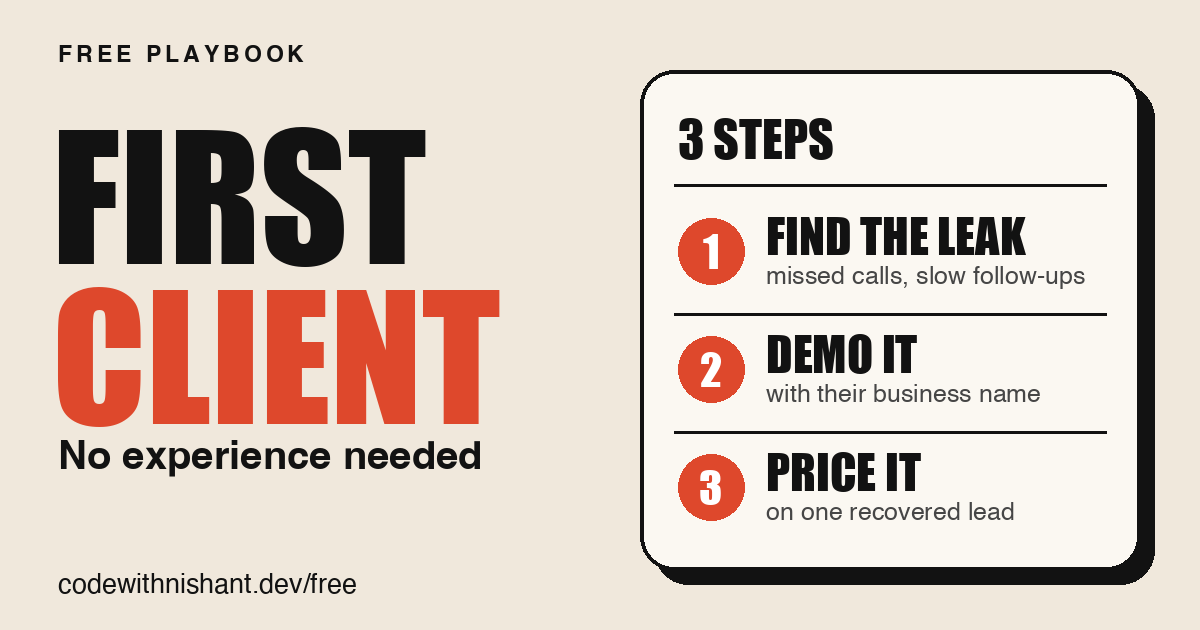
Most beginners wait. They take one more course, learn one more tool, build one more project. Then they feel ready to talk to a business. That day never comes, because the gate was never experience.
This is the guide promised in the reel: comment CLIENT and you land here. It is a short, practical way to get your first paying client in AI and automation with no portfolio and no track record. You pick one type of business, find one leak, show the fix with their name on it, and ask one question.
Nobody buys your experience. Everybody buys their problem gone.
// Build this with your AI agent
Build this with your AI agent
Want to try this? Copy the setup prompt into your AI agent with this guide's link.
Read this guide: https://codewithnishant.dev/free/first-client-playbook/ . Help me find my first client using its method. First ask me which type of local business I want to start with and in which city or country. Then, using only public information (their website, their map listing and public reviews), find 10 real businesses of that type and check each one for the leaks in the guide: missed calls, slow follow-ups, no online booking. Write down what you saw and where you saw it, and do not guess. For the 3 best matches, draft the one-question message from the guide and a short plan for a demo with that business's name on it. Do not contact anyone, do not send any message, and do not collect private data. Save everything in one file for me to review, and tell me which businesses you could not check and why. Ask before paid services or publishing.
01. Experience is not what they buy
What owners actually pay for
A business owner is busy. They do not read your CV, and they do not care which model you used. They care that the phone keeps ringing out, or that leads go cold, or that people book and never turn up. They want that one thing gone.
| What beginners think owners want | What owners actually buy |
|---|---|
| Years of experience | One problem gone |
| A big portfolio | A demo with their own business name on it |
| The newest AI tool | Something that works without them thinking about it |
| A long proposal | One clear question and a simple price |
I have built 100+ systems for real businesses since 2021, and the pattern is the same. Nobody hired me for knowing every tool. They hired me to fix one painful thing. I wrote about that in the one thing beginners get backwards. This guide is the practical version: the exact steps.
What Mark Cuban says, and what he does not
Mark Cuban has pointed beginners at small and mid-size businesses more than once. In an interview with CNBC Make It, he said that if he were a teenager again he would learn AI and then approach small and medium businesses that do not understand it yet (CNBC).
In a later CNBC Make It interview, reported by Fortune in November 2025, he gave the reason. Small and mid-size firms often lack in-house AI depth, and big companies already have IT teams. He said a newcomer can stand out by building simple agents that automate time-consuming work, work that often goes undone because "manual labor is too expensive". Fortune also cites a CNBC and SurveyMonkey survey: 37% of small business owners use AI tools and 71% plan to invest more.
That is the direction: go where the need is, and show the work. What he does not give is a method or a promise of income. The steps below are mine, and I am not saying Cuban endorses this playbook.
02. Pick one niche and one leak
Narrow beats clever
Do not sell "AI" to "businesses". Pick one type of business in one city, and one leak that type of business has. Then every demo, message and calculation you make works again for the next ten businesses like it.
A leak is a place where a customer reaches the business and then gets lost. The three that show up most often:
- Missed calls. Nobody picks up, the caller tries someone else.
- Slow follow-ups. An enquiry comes in and the reply takes hours or days.
- No-show bookings. People book, then forget, and the slot goes empty.
Here are starting points. They come from the kinds of businesses I have built for (real estate, healthcare, solar) plus common local services. They are places to look, not statistics.
| Business type | Common leak | Where you can see it |
|---|---|---|
| Clinics and dental practices | Missed calls, no-shows | Phone rings out in working hours, no online booking |
| Real estate agents | Slow reply to enquiries | Enquiry form with no instant reply |
| Solar installers | Slow quotes, lost enquiries | No quick answer to a quote request |
| Salons, gyms, coaches | Unanswered messages, no-shows | DMs sit unread, booking only by phone |
| Home services (plumbers, cleaners, roofers) | Missed calls while on a job | One phone number, nobody to answer it |
Before you commit to a niche, ask three questions:
- Do they get calls or enquiries every day? A leak only costs money if there is traffic.
- Is one customer worth real money to them? The bigger the value of one customer, the easier the price.
- Can you reach the owner? A one-person clinic is easier than a chain with a head office.
Choose something you can already talk about for two minutes without notes. That is enough to start. The depth comes after the first few clients, not before.
03. Step 1: Find the leak from outside
Look before you talk
You do not need access to their systems to see a leak. A customer sees it from the outside, so you can too. Use public information only, and write down what you saw, with the day and time.
- Call them yourself. Once when they should be open, once just after closing. Does it ring out? Does voicemail pick up? Is there a way to book?
- Read their public reviews. Look for lines like "never picks up", "no reply" or "had to call three times". Real customers describe leaks for you.
- Check the website. Is there a booking link, an instant reply to the contact form, a WhatsApp or chat option?
- Send one enquiry. Use the form or a message, once, like a normal customer. Note how long the reply takes. Do not send more than one.
| What you see | The leak | A demo that fits |
|---|---|---|
| Rings out at 6:40pm, no voicemail | Missed calls | Instant text to every missed call with a booking link |
| Form submitted, no reply after a day | Slow follow-up | Instant reply that asks two questions and offers a time |
| Reviews mention long waits for a call back | Missed calls and follow-up | Missed call text plus a reminder when nobody has replied |
| Booking only by phone | Lost bookings | A simple message flow that books and sends a reminder |
Keep a small sheet with four columns: business, leak you saw, proof (date and time), demo idea. Aim for 10 businesses. Stop when you have 3 where the leak is clear.
When you reach out later, you will say what you saw, not what you assume. "I called at 6:40pm on Tuesday and it rang out" is a fact. "Your business has a problem" is an insult.
04. Step 2: Demo it with their name
No proposal, no portfolio
A demo beats a pitch deck, because it shows the fix instead of describing it. Build the smallest thing that fixes the leak you saw, and put their business name on it. The demo is your portfolio.
Start at the bottom of this ladder and only go up if the demo needs it:
| Level | What it does | Needs AI? |
|---|---|---|
| 1 | A missed call triggers an instant text with a booking link | No, a trigger and a template |
| 2 | A chat reply that answers a few common questions and collects a name and a time | Yes, a simple one |
| 3 | A voice agent that answers the call | Yes, and more care |
Level 1 is the right first demo for most missed-call leaks, and it is my suggestion, not a rule. It is quick to build and easy for an owner to understand. If you want to go further, these guides cover the next pieces: the Lead Loop for following up every lead, an open-source AI receptionist for phone lines, and how to land voice agent clients with a demo before the call.
How to make the demo:
- Use their public business name and opening hours, taken from their website. Leave out their logo, so it cannot look like their official system.
- Run it on a test number or test account of your own. Never on their live phone line.
- Record a screen video of about 60 seconds. Show what the customer sees, then what the owner sees.
- Test it on your own phone and with one friend before you send it.
The video is what you send, not a document. Owners watch a minute. They do not read a proposal from a stranger.
05. Step 3: Price it on one lead
Make the maths do the selling
Do not price by your hours. Price against what one customer is worth to them. If one recovered customer pays for the month, the deal mostly closes itself.
Example, not a real client. A clinic misses about 10 calls a week. Say 3 of those callers would have booked, and one booking is worth $100.
| Example line | Example number |
|---|---|
| Missed calls per week | 10 |
| Would have booked | 3 |
| Value of one booking | $100 |
| Lost per month (3 x $100 x 4 weeks) | about $1,200 |
| If your fix recovers just 1 a week | about $400 a month |
In this example, a monthly fee well under $400 is easy to say yes to. These are made-up numbers to show the method. Use their numbers: ask how many calls they think they miss and what one customer is worth.
My rules of thumb for pricing:
- Charge a small setup fee and a monthly fee. Pick the amounts from their maths, not from a price list.
- Keep the monthly fee a small fraction of what one recovered customer is worth.
- Never promise a result. Say "in this example". After 30 days, show their real numbers from their own system.
- Start with one process. You can add the next one when the first works.
06. The one-question pitch
The silence is the pitch
How many leads did you lose last month?
That is the whole pitch. Most owners have never counted. They have to think, and in that pause they do your selling for you. Ask the question, then stop. Do not fill the silence with features.
When they answer, even with a guess, you ask one more thing: "Want me to show you a 60 second demo of a fix?" Then you send the video.
The first message (DM or WhatsApp)
Hi [Name], quick question about [Business]:

How many leads did you lose last month because nobody picked up?
When they reply
Thanks [Name]. I called [Business] on [day] at [time] and it rang out, so I made a 60 second demo of a fix with your name on it. Want me to send it?If you walk in
Hi, I help local businesses stop losing calls. How many leads do you think you lost last month? I can show you a 60 second fix on my phone.Rules for sending:
- Send to about 5 businesses a day, each one written for that business. Not 100 copy-pasted messages.
- Say only what you saw. If you did not call them, do not write that you did.
- Follow up slowly. Once after about a week with something new you noticed, once after about three weeks, then stop. Daily nagging kills the deal. This spacing is my suggestion.
- No prices in the first message. Price comes after the demo.
07. Objections, with answers
You will hear these
| They say | You can say |
|---|---|
| "Do you have experience?" | "I would rather show you than tell you. This demo has your name on it. Try it for a week and judge it." |
| "We are fine, we do not miss calls." | "Good. Can I count your missed calls for one week so we both know the real number?" |
| "It is too expensive." | "Let us check the maths: what is one customer worth to you? If one recovered customer covers the month, the fee is small. I can also start with a smaller scope." |
| "I do not trust AI." | "It only sends a text and hands over to you. You see every message it sends, and you can switch it off at any time." |
| "I need to ask my partner or IT person." | "Of course. I will send a one page summary and the video, so they can see it in a minute." |
| "Send me a proposal." | "Happy to. A 60 second video shows it faster than a document. Can I send the video first?" |
Only say what is true. If you cannot do something, say so. A small honest yes beats a big promise you cannot keep.
08. After they say yes
Start small and keep it clean
- Write a one page scope. What it does, what it does not do, how long the first trial runs, the price, and how either side can stop.
- Take payment before you switch anything on. Even a small amount. It makes the trial real. This is my rule, adjust it to your market.
- Put accounts in their name. The phone number, the booking tool and any paid tools belong to them. You get only the access you need.
- Test with them. Call the number together. Let them see a message arrive on their own phone.
- Check every day in week one. Read the messages the system sent. Fix anything odd the same day.
- Send a short weekly report. Missed calls, texts sent, bookings. Real numbers from their system, nothing rounded up.
Start with one process on one phone line for one month. When it works, offer the next one, for example reminders for no-shows. The lead follow-up pattern in the Lead Loop is a natural second step.
09. Stay safe and honest
Small habits that protect you and them
- Test on your own number. Never touch their live phone line, calendar or customer list without their written yes.
- Check the rules where you live. Rules on recording calls, sending texts and storing customer data differ by country. Check yours before you go live. This guide is not legal advice.
- Protect their customers' data. Do not paste real customer details into public AI tools without permission, and only keep what you need.
- Be clear it is automated. A text that says it is an automatic reply and offers a human follow-up builds trust.
- Never invent results. No made-up client names, no made-up numbers. Example maths must say "example".
- Keep a human in the loop. The system should hand over to the owner for anything it cannot answer.
10. Turn client one into proof
Your second client is easier
After about 30 days you have something no beginner has: a real result. Use it, but only with their permission.
- Ask for a written yes before you share anything about them. Offer to hide their name if they prefer.
- Take the numbers from their system: missed calls, texts sent, bookings. Real figures only, with the dates.
- Ask if they would say one line about it in their own words. Use only the words they give you.
- Then go back to your niche list and write to the next five businesses like them.
If the result is small, say it is small. A true small result is worth more than a big one nobody believes.
11. Your first 7 days
A suggested plan, not a promise
| Day | Do this |
|---|---|
| 1 | Pick one business type, one city and one leak |
| 2 | List 10 businesses and check each one from outside (section 03) |
| 3 | Build the simplest demo for the leak you saw most |
| 4 | Record the 60 second video and test it with a friend |
| 5 | Send the one-question message to 5 businesses |
| 6 | Reply to answers, send the video to anyone who says yes to seeing it |
| 7 | Review what you got. Fix the demo or the message, and send 5 more |
Seven days will not guarantee a client. It will guarantee you have talked to real businesses with something real in your hand, which is more than most people do in a month of learning.
12. Mistakes beginners make
Skip these
- Selling AI instead of the problem. Owners buy fewer lost leads, not a technology.
- Building before checking the leak. You make a demo for a problem they may not have.
- Choosing five niches. You redo all the work every time.
- Sending to 100 businesses at once. Five good messages beat a hundred bad ones.
- Pricing by hours. Owners think in customers, not in your time.
- Promising numbers. You cannot know the result before you start. Use examples, then real data.
- Touching their live systems with no written yes. One mistake on their phone line can cost you the client.
- Waiting for a portfolio. A 60 second demo with their name on it is the portfolio.
- Giving up after one message. Follow up, slowly, once or twice, then move on.
13. FAQ
Do I need experience to land my first AI client?
No. A business owner is not buying your experience. They are buying one problem solved, like missed calls or slow follow-ups. A short demo with their business name on it shows that you can solve it, and it is more convincing than a CV. You do need to build something that works, and be honest about what it does and does not do.
What did Mark Cuban actually say about small businesses and AI?
He told CNBC Make It that if he were a teenager again he would learn AI and approach small and medium businesses that do not understand it yet. In a later CNBC Make It interview, reported by Fortune in November 2025, he said small and mid-size firms often lack in-house AI depth and that a newcomer can stand out by building simple agents that automate time-consuming work. He does not give a pricing method or promise income. The steps in this guide are mine.
Which type of business should I start with?
Pick one type in one city, where the business gets calls or enquiries every day, one customer is worth real money, and you can reach the owner. Clinics, real estate agents, solar installers, salons and home services are good starting points because missed calls and slow follow-ups cost them customers. Choose one you can already talk about for two minutes.
How do I price my first AI automation?
Price against what one customer is worth to them, not your hours. Ask how many calls they think they miss and what one customer is worth, then work out what a small recovery is worth per month. Charge a small setup fee and a monthly fee that is a fraction of that. Never promise a result, and show their real numbers after 30 days.
What should I build for the first demo?
Build the smallest thing that fixes the leak you saw. For missed calls, that is often an instant text with a booking link, which needs no AI. If the demo needs it, add a simple chat reply that answers a few common questions. Put their business name on it, run it on your own test number, and record a 60 second video.
Is it okay to build a demo before they agree?
Yes, if you use only public information, run it on your own test number and never touch their live systems. Use their public name and opening hours, leave out their logo, and say clearly that it is a demo you made. Get their written yes before you connect anything to their real phone line, calendar or customer data.
14. Sources and what I checked
Checked 11 October 2026
News pages change and quotes get updated. Recheck them before you rely on them. These are the sources for the Mark Cuban facts in this guide.
- Fortune, 17 November 2025: Cuban's advice on small and mid-size firms and simple AI agents, and the CNBC and SurveyMonkey survey figures (37% and 71%), which are Fortune's report of that survey.
- CNBC Make It: Cuban on learning AI and approaching small and medium businesses that do not understand it yet.
What I checked, and what I did not
I read the Fortune article on 11 October 2026 and checked the Cuban claims in this guide against it. The CNBC claim is in the CNBC piece as reported and syndicated by other outlets, and I could not reopen the CNBC page itself on the day, so recheck it. The method, the templates and the pricing rules come from my own work building systems for businesses since 2021, and they are my opinion, not facts from a source. All numbers in the pricing section are examples, not results. I give no income, conversion or success-rate figures, because I have none to cite. Rules on calls, texts and data differ by country, and this is not legal advice.
Nobody buys your experience. Find the leak, show the fix with their name on it, and ask the one question.
// Free newsletter
I send out guides like this every week
Real setups, real sources, no hype. Drop your email and I'll send you the next one.