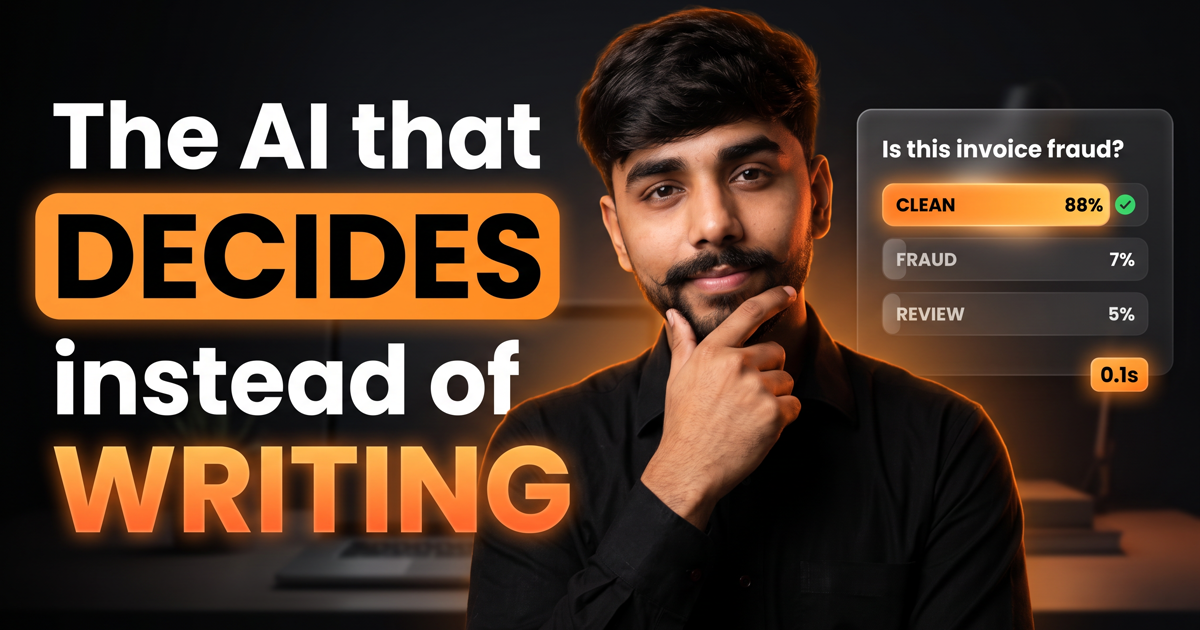
01. What is Jev?
The short answer. Jev is a new AI model from TypeSafe AI that makes decisions instead of writing text. You give it a situation and a few options. It picks the best one and tells you how sure it is, in a fraction of a second.
- Launched: September 15, 2026 (founder's launch post)
- Built by: TypeSafe AI, founded by Diogo Almeida, an ex-OpenAI researcher who worked on ChatGPT research (Forkast)
- What it outputs: a choice plus a confidence score for every option. No paragraphs.
- How the company describes it: "smart if-statements" (typesafe.ai)
It went viral the week it launched. It hit X's trending page, and one analysis looked at 12,759 tweets about it (OpenChamber).
02. Jev vs ChatGPT and Claude
Jev does not replace them. They do different jobs.
| ChatGPT / Claude | Jev | |
|---|---|---|
| What it gives you | Text: answers, code, essays | A decision plus confidence scores |
| Can it chat? | Yes | No, it cannot write a sentence |
| Speed | Seconds | 70 to 500 milliseconds |
| Cost | You pay for every word it writes | $0.042 per million input tokens, output is free |
| Best for | Thinking, writing, explaining | Picking, sorting, scoring, routing |
Speed and price: TypeSafe launch post.
The invoice example
Ask a normal AI "is this invoice fraud?" and it writes you a paragraph, which takes seconds. Ask Jev and you get the odds in about 0.1 seconds:
- 88% clean
- 7% fraud
- 5% send for review
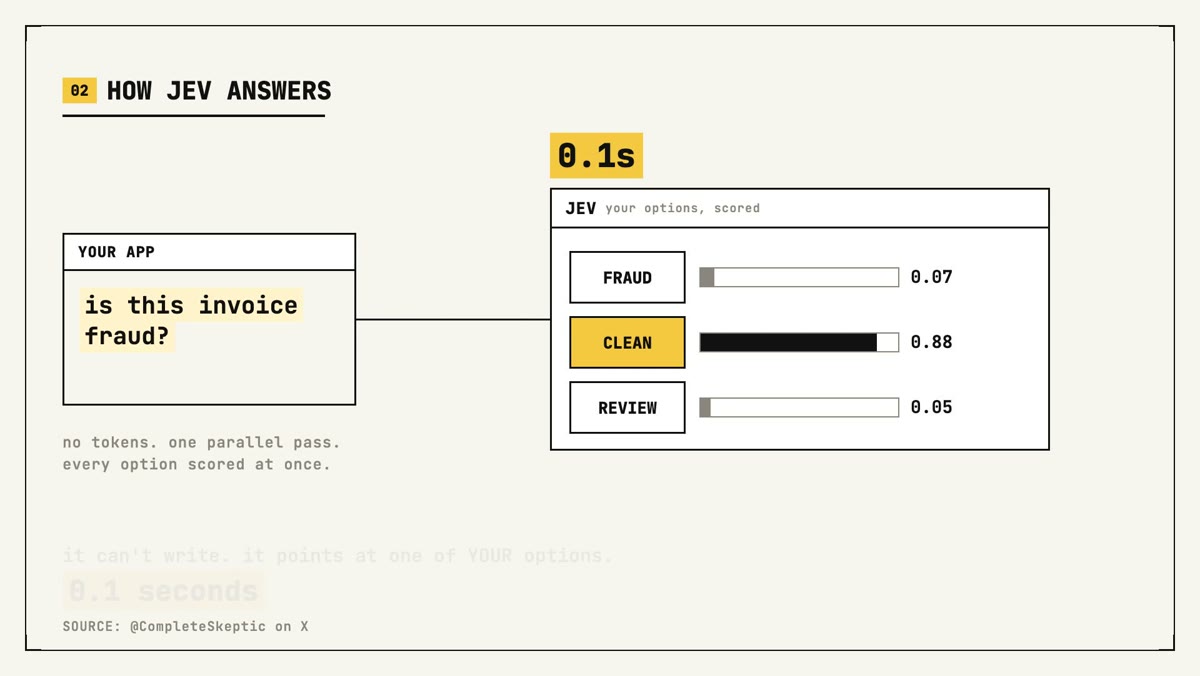
Software does not need a paragraph. It needs a decision it can act on. That is the whole idea.
03. 3 real things people built in week one
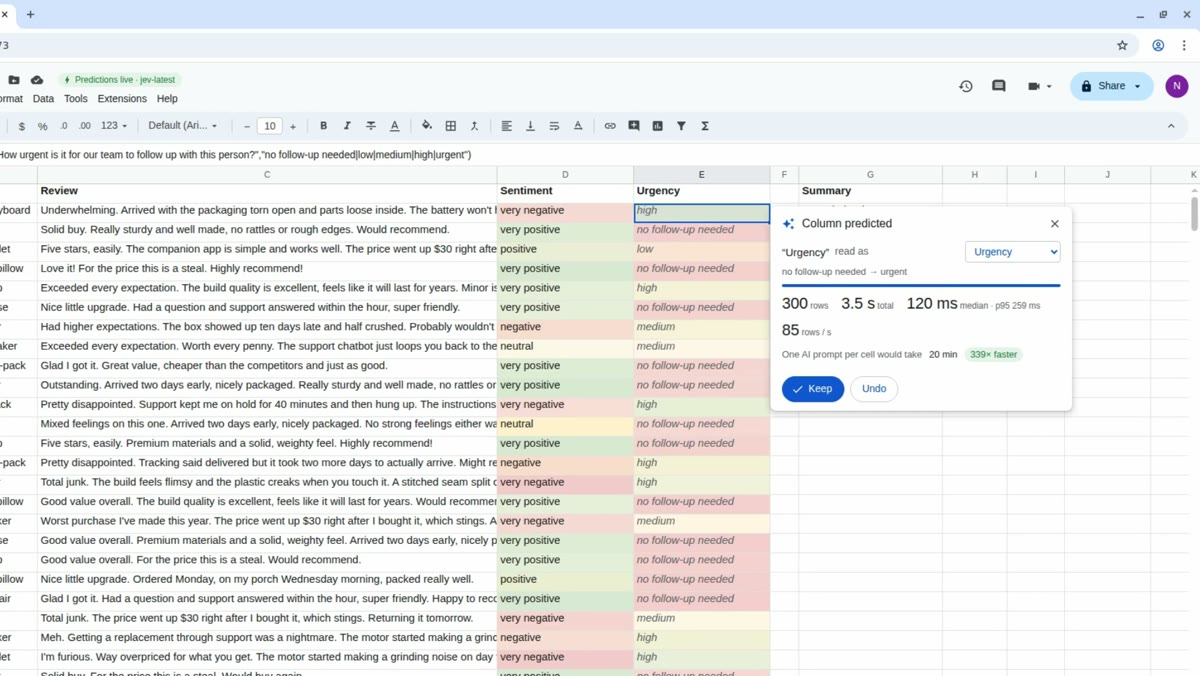
1. A spreadsheet that rates every row
- What: Nader Dabit typed "Urgency" as a column header. Jev understood the job as he typed and rated every row, from "no follow-up needed" to "urgent".
- Speed: around 100 milliseconds per row.
- Why Jev fits: each row is one small decision, repeated hundreds of times.
2. A self-driving car simulator
- What: Kaveh Mousavi Zamani fed Jev the car's sensor data: speed, pedestrians, speed limit.
- Decision: in real time, Jev picks whether to steer, brake or overtake.
- Why Jev fits: driving is fast choices from a short list, not writing.

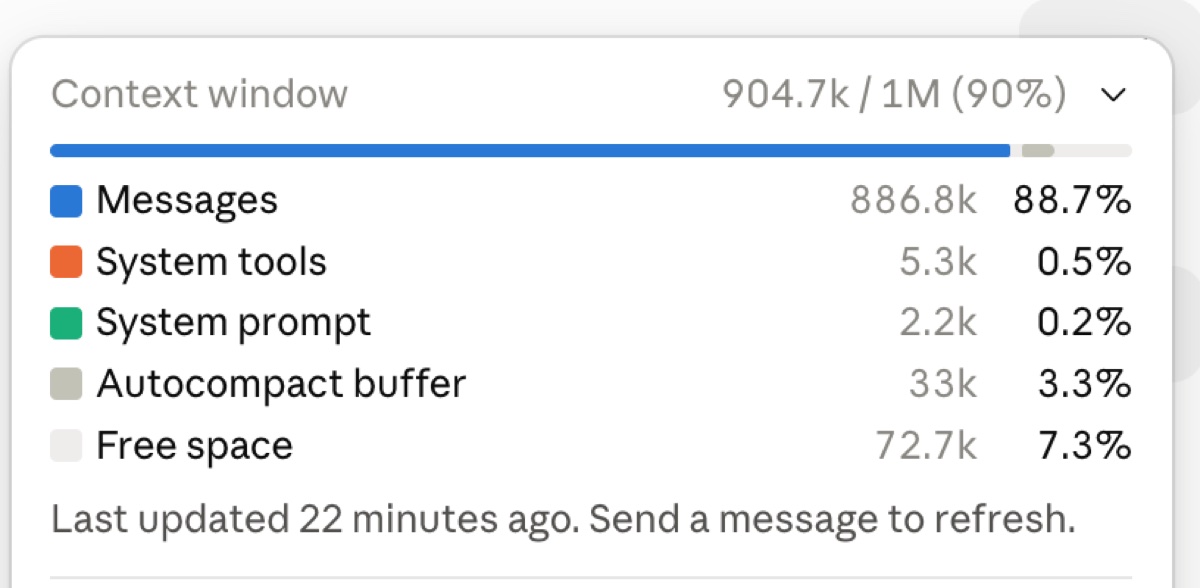
3. A plugin that cut a Claude session from 1M to 86K tokens
- What: Alex Volkov's Claude session had grown to almost 1 million tokens. He added a Jev plugin that scores every tool call as useful or unnecessary, then removes the unnecessary ones.
- Result: in about 1 second, the session dropped to 86 thousand tokens.
- Why Jev fits: thousands of yes-or-no calls, where speed and price matter most.
Daniel San went a step further and built a Claude Code router on top of Jev.
04. The pattern: Claude thinks, Jev decides
None of these three asked Jev to write anything. They only asked it to decide:
- which row is urgent
- when to brake
- which tool call is unnecessary
Fig 1. Use the big model for thinking. Use Jev for the hundred small decisions around it.
The rule: if you make an AI write an essay for every small decision, you pay an essay-sized bill.
05. Practical ways to use Jev
This is what the reel promised. Every one follows the same shape: a situation goes in, a short list of options, Jev picks one.
1. Sort leads: hot, warm or cold
- In: a form entry or a call summary
- Options: hot / warm / cold
- You save: no one reading every lead by hand. Hot ones get a call first.
2. Route support messages
- In: a customer email or chat message
- Options: billing / technical / refund / urgent
- You save: the right person gets it straight away, not after a manual triage.
3. Flag invoices and payments for review
- In: invoice details
- Options: clean / suspicious / review
- You save: your team only checks the few that look off.
4. Triage WhatsApp messages for a business
- In: an incoming customer message
- Options: booking / price question / complaint / spam
- You save: a clinic or a real estate office replies to the right ones first.
5. Pick which tool an AI agent should use
- In: the agent's current task
- Options: search / calculator / database / ask a human
- You save: the big model stops burning tokens on "which tool now?"
6. Tag content and comments
- In: a comment, a review, a post
- Options: positive / negative / question / needs reply
- You save: hours of reading, and the questions never get missed.
The test for any idea: can the answer be one item from a short list? If yes, it is a Jev job. If the answer needs a paragraph, it is a Claude or ChatGPT job.
06. How to start
- Step 1. Join early access on typesafe.ai.
- Step 2. Try it in the playground first. Paste a situation, give it 3 or 4 options, see what it picks.
- Step 3. Move to the API console when one decision works well.
- Step 4. Start with one boring decision you make 50 times a day. Not your hardest one.
Cost: $0.042 per million input tokens, and output is free (TypeSafe). For small decisions, that is close to nothing.
07. When not to use Jev
- You need text. Emails, summaries, explanations. Jev cannot write them.
- The options are not clear. If you cannot list the choices, Jev cannot pick one.
- The stakes are high. For money, health or legal calls, use Jev to sort, and keep a human on the final decision.
- You have not tested it. It launched in September 2026. Try it on your own data before you trust it.
08. Related guides
- What is an AI agent? The part you were never told: where a decision model fits inside an agent.
- Sell one automation: turn a use case like lead sorting into a paid service.
- Tel-Agent: an open-source AI receptionist: another tool for triaging business calls and messages.
- Claude Code memory setup: keep long Claude sessions lean, the same problem the token plugin solves.
09. FAQ
What is Jev?
Jev is an AI model from TypeSafe AI that picks the best option from a list and gives a confidence score for each one. It does not write text.
Is Jev a large language model like ChatGPT?
No. ChatGPT and Claude write text. Jev only makes decisions, which is why it is much faster and cheaper for that job.
How fast and cheap is Jev?
TypeSafe says a response takes 70 to 500 milliseconds and costs $0.042 per million input tokens, with output free.
Will Jev replace ChatGPT or Claude?
No. Use Claude or ChatGPT for thinking and writing, and Jev for the many small, fast decisions around them.
How do I get access to Jev?
Join early access on typesafe.ai, test it in the playground, then use the API console.
10. Sources
- TypeSafe AI: Introducing System One models and Jev. What Jev is, speed, price, access.
- typesafe.ai. The "smart if-statements" description.
- Diogo Almeida's launch post, September 15, 2026.
- Forkast: Jev is not an LLM, and that may be the point. Founder background.
- X trending page for Jev.
- OpenChamber: a study of 12,759 tweets about Jev.
- Matija Sosic's 45-second explainer. The invoice example.
- Nader Dabit. Predictive spreadsheet.
- Kaveh Mousavi Zamani. Self-driving simulator.
- Alex Volkov. Token-cleaning plugin, 1M to 86K.
- Daniel San. Claude Code router.
// Free newsletter
I send out guides like this every week
Real setups, real sources, no hype. Drop your email and I'll send you the next one.