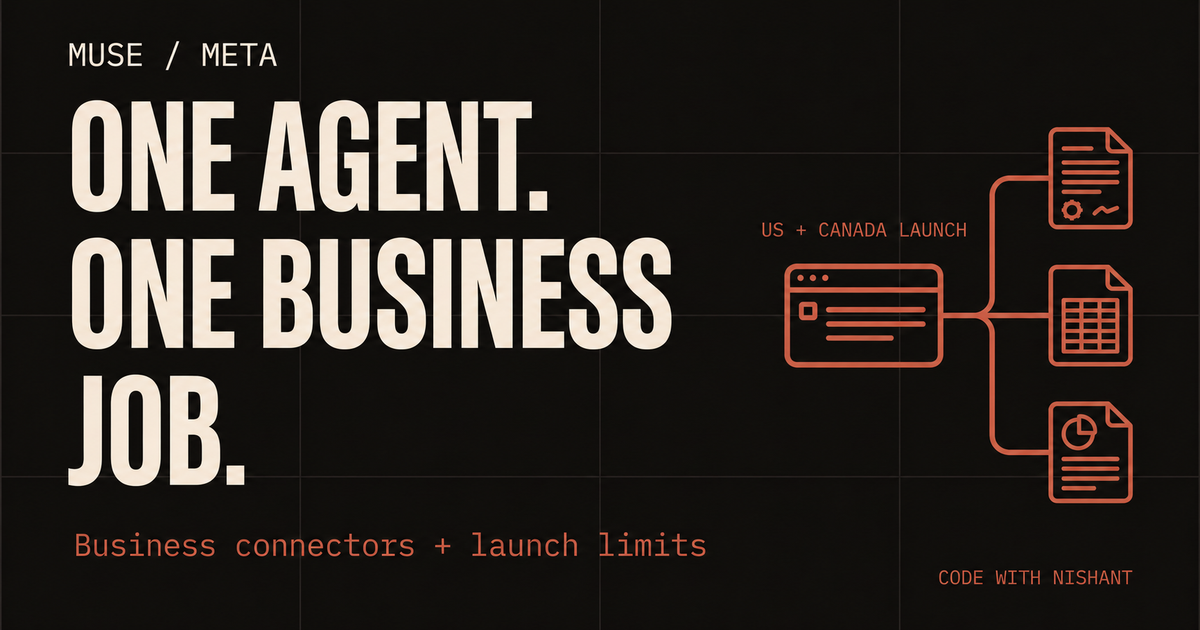
Meta announced Muse for Small Business on 29 September 2026. The update adds connectors for tools such as Notion, Slack, Shopify, Canva and QuickBooks, along with Meta business accounts. The announcement describes the existing personal-agent launch as available in the US and Canada. Do not assume access on an Indian account. Meta announcement.
The useful idea is giving an agent a job across the records your business already uses. I would start with a draft or a sourced brief, then inspect the work before increasing its responsibility.
What changes when the agent has context?
Meta describes Muse as operating through a dedicated cloud computer, with a browser and the ability to continue tasks in the background. The owner controls connections and approvals. The small-business announcement explicitly keeps publishing, sending and spending behind owner approval. Muse overview, business update.
A connected tool gives the agent a source to work from. You still need to tell it which records matter and what a useful result looks like.
Start with a daily brief
Here is an illustrative first task. It is not a claimed client outcome:
Prepare a daily brief from the connected sources I name.
Show the three items that need my attention today.
For each item, include its source, why it matters and a proposed next step.
Separate confirmed facts from suggestions.
Prepare drafts when useful, but do not send or publish them.
If a source is missing or conflicting, say so.
Notify me when the brief is ready or a decision is required.
Review it for a few runs. Did it find the right records? Did it miss a commitment? Did it bring you repeated items that were already done? A short accurate brief is more valuable than a long list of plausible priorities.
Then try a bounded campaign draft
Connect the relevant, permission-cleared content and sales records. Define the date range and the audience. Ask for source-backed observations and a draft, rather than an unsupported promise of growth.
Use [named content records] and [named sales summary] for [date range].
Identify which observations are supported by the data.
Draft one campaign for [audience and offer].
Give me the hook, message, channel and proposed next action.
Label assumptions and any example math.
Do not invent testimonials, customer results or performance figures.
Do not publish, change ads or spend money.
If the records do not support a conclusion, a good response tells you what is missing. It should not fill the gap with a confident story.
A small delegation agreement
| Field | Example |
|---|---|
| Responsibility | Prepare next week's campaign draft |
| Inputs | Selected posts and an approved sales summary |
| Output | One brief with sources, assumptions and draft copy |
| Approval | Owner reviews the exact copy before publication |
| Stop condition | Missing access, conflicting data or an external action |
These are operating choices you can make around an agent. They are not a claim that every field above is a built-in Muse setting.
Muse and OpenMuse are different products
Muse is Meta's hosted product. OpenMuse is a separate CopilotKit application with MIT-licensed source and its own configuration and service dependencies. If you want to build on code, read the OpenMuse guide. If you want to use Meta's product, check Muse's current account access and connector list. Meta product, CopilotKit repository.
What to check before connecting business accounts
Use the minimum access needed for your first task. Verify the connected account, the data available to the agent and the actions that still require review. Meta's security article describes credential handling, a separate Sentinel component and permission boundaries. Those are the vendor's design claims, not an independent audit from this guide. Security design.
Keep your own accepted output and decision record. That makes it easier to compare the next run and notice when an instruction needs to change.
FAQ
Can I use it in India today?
The cited announcement does not establish Indian access. Check the current official availability and your actual account.
Can it publish a campaign without my approval?
Meta says publishing, sending and spending require approval. Preserve that distinction when you write your task brief.
What is a sensible first task?
One sourced brief or draft with a clear finish line. Expand after checking the result.
Sources
- Muse for Small Business.
- Meta's dated X announcement.
- Muse product overview.
- Design explanation.
- Security explanation.
Checked 1 October 2026. Task briefs are examples you can adapt, not a claim that I tested Muse on a business account.