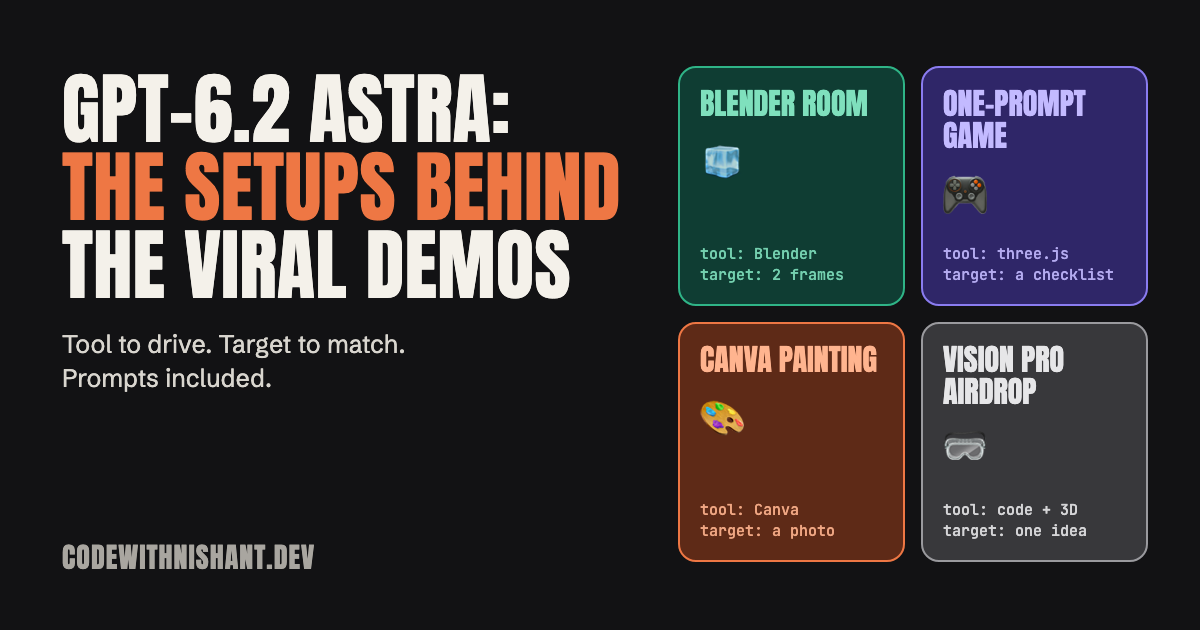
GPT-6.2 Astra came out on 17 November 2026. Within two days people were posting rooms, games and 3D builds made with it.
Look closely and the good demos have one thing in common. Nobody typed a clever one-line prompt. They gave the model a real tool to drive and a target to match, then let it keep going.
Here is each setup, so you can try the same pattern on your own idea.
A tool to drive. A target to match. Room to keep going.
// Build this with your AI agent
Build this with your AI agent
Want your AI assistant to set one of these up with you? Copy this prompt into Codex, ChatGPT or any coding agent, together with this guide's link.
Read this guide: https://codewithnishant.dev/free/gpt-6-2-astra-setups/. I want to build [WHAT YOU WANT TO MAKE, for example a 3D room in Blender, a small browser game, or a painting from a photo]. Pick the setup from the guide that fits best and walk me through it one step at a time. First list what I need to install, and wait until I confirm each install works. Then give me the starting prompt from the guide, filled in for my idea, with a clear target the model can check its work against. Tell me where the model usually stops early and what to type to push it on. Do not buy anything, sign me up for anything or share my files. At the end, tell me what is still untested.
01. The pattern
What the good demos share
| Build | Tool it drove | Target it matched |
|---|---|---|
| Blender room | Blender, through Codex | Two frames from a real video |
| Voxel game | A plain coding harness | A detailed game prompt |
| Canva painting | Canva, in the browser | A photo |
| Vision Pro AirDrop | Code, plus two 3D tools | One interaction idea |
The target is the important part. A target gives the model something to compare its own work against, so it can see what is wrong and fix it without you spelling out every step.
02. A Blender room from two frames
OpenAI's own demo
In OpenAI's launch video, the presenter stands in front of a green screen. The team gave Codex with GPT-6.2 Astra just two frames from the start of the video and asked it to rebuild the set in Blender, matching the camera blur and the studio lights. Astra kept adjusting the scene until it matched the frames. Then they asked it to turn the room into a scene you can walk around in like a game.
The setup. Codex connects to Blender through an MCP server, so the model can run Blender commands and look at the result. One open source option is blender-mcp. Follow its README to install the Blender add-on, then add the server to your Codex config. OpenAI did not say which connection it used.
Starting prompt (my template)
I attached two frames from a video. Rebuild this room in Blender using the Blender tools you have. Match the camera angle, lens blur and lighting. After each pass, render from the same camera, compare your render with the frames, list what is still different, and fix it. Keep going until the render and the frames match closely, then tell me what you could not match.03. A full game from one prompt
QuartzRouter's Minecraft test
The creator behind QuartzRouter's video gave Astra the same Minecraft-style prompt he had earlier given Claude Fable 5.2, in a plain harness with no skills, extensions or MCP. It ran for about an hour. The result had caves, deer, berry bushes, snow, fog, different trees, mining and fall damage. He said the graphics compete with Fable, and that Fable's gameplay was more polished.
He reported about 1.78 dollars of usage through his own router at a discount, so your cost will be different. Gaps he pointed out: no weapons, a camera that snaps, and no way to climb out of water.
Starting prompt (my template)
Build a voxel sandbox game that runs in the browser with three.js. Include: a generated world with hills, caves and water, at least three tree types, day and night, mining and placing blocks, fall damage and simple animals. Work in steps. After each step, run the game, check it against this list, write down what is missing or broken, and fix it before you move on. Do not stop until every item on the list works.04. Painting inside Canva
Nate Herk's 12-task test
In Nate Herk's Astra vs Fable video, both models got the same prompt to recreate a photo as a painting inside Canva, using the browser. Astra hit Canva's limit on brush strokes, so it exported the canvas and kept painting around the limit on its own. Fable stalled on the same task. He reports about 1.5 hours and about 7.50 dollars for Astra, against about 3 hours and about 63 dollars for Fable.
This is where testers keep praising Astra: using real apps on a screen. Nate said Astra "always seems to crush" Claude Code at computer and browser use.
Starting prompt (my template)
Open Canva in the browser and recreate the attached photo as a painting on a blank design, using brush strokes and shapes only. Compare your canvas with the photo every few minutes and fix the biggest difference first. If Canva blocks you or hits a limit, find a way around it inside Canva, explain what you did, and keep going.05. A Vision Pro AirDrop
Three tools, one idea
One artist built an AirDrop for Apple Vision Pro: you pinch a photo off your iPhone, open your hand, and you are standing inside it. In their words, they vibe-coded the interaction with 6.2 Astra, turned one photo into a 3D scene with ML-SHARP, and made the ginkgo leaves with Tripo.
The lesson is to split the job. Astra wrote the code for the interaction. Dedicated tools made the 3D parts. You do not need one model to do everything.
06. Where Astra falls short
Read this before you switch
| What testers saw | Who said it |
|---|---|
| "The worst model OpenAI has ever released" | Theo, who had early access |
| Stops early on coding and has to be pushed. Nobody on their team switched to it | Every, after 2 weeks of testing |
| Fable won 7 of 12 tasks, Astra won 5, but Fable cost about 7 times more | Nate Herk |
| Same three.js scene, 5 h 34 min each: Fable's file 242 KB, Astra's 32.9 MB | Dominik Scholz |
| Hard to steer, but delivered on an ambitious Blender and Unity project | Ethan Mollick |
What to do about it: give Astra a checklist or a target, and when it stops early, tell it plainly which items are still not done. That is also why every prompt above asks it to compare its work with the target.
07. What it costs
| Item | Number |
|---|---|
| API price, input | 8 dollars per million tokens |
| API price, output | 40 dollars per million tokens |
| Artificial Analysis Intelligence Index | Astra 62, Fable 5.2 65, Opus 5.5 59 |
| Cost per index task | About 4 dollars for Astra, about 26.54 dollars for Fable |
The per-token price is not the story. Astra gets cheaper per job because it uses fewer tokens. Prices are from SiliconANGLE's launch report, and the index numbers are as reported by Requesty. Check OpenAI's pricing page before you plan a budget.
08. Get help building yours
Every week I run a free mentorship call on my Discord. Bring the build you are stuck on, whether it is a Blender scene, a game or something for work, and we look at it together.
If you want one-on-one time on your own project, you can book a 1:1 mentorship session for ₹999.
Using AI on bigger jobs? The Fable 5.2 settings guide covers the same kind of long runs on Claude's side.
09. FAQ
What is GPT-6.2 Astra?
OpenAI's model for demanding work like research, coding and 3D, released on 17 November 2026 together with GPT-6.2 Sol for everyday tasks. Both are in ChatGPT, Codex and the API.
How much does GPT-6.2 Astra cost?
OpenAI lists 8 dollars per million input tokens and 40 dollars per million output tokens in the API. Artificial Analysis measured about 4 dollars per task on its index, against about 26 dollars for Claude Fable 5.2, because Astra uses fewer tokens.
Is GPT-6.2 Astra better than Claude Fable 5.2?
Not across the board. Artificial Analysis scores Fable 65 and Astra 62. In Nate Herk's 12-task test Fable won 7 and Astra won 5, but Astra was far cheaper and faster. Testers say Astra is strong at 3D and at using apps, and weaker at polished code and writing.
Do I need to code to try these setups?
You need to be comfortable installing a few tools and pasting commands. The game and painting setups work from a plain prompt. The Blender setup needs Blender, Codex and an MCP server, which takes some setup the first time.
Did you build these yourself?
No. These are other people's builds, credited by name with links to their posts and videos. The prompts in this guide are my own starting templates based on what they described, not their exact prompts.
10. What I checked
Checked 19 November 2026
I watched and transcribed OpenAI's launch videos and the creator videos linked above, and read each X post on 19 November 2026. Every build and number in this guide comes from those sources and is credited to the person who reported it.
I did not run these builds myself, and I did not test the starting prompts end to end. Treat them as a first draft to adapt. Model behaviour and prices can change after a launch, so check OpenAI's own pages before you rely on a number.
The model matters less than the setup. Give it a tool, a target and room to keep going.
// Free newsletter
I send out guides like this every week
Real setups, real sources, no hype. Drop your email and I'll send you the next one.